195 lm/W S‑LINE Community Supermarket Lighting – OK Foods – South Africa
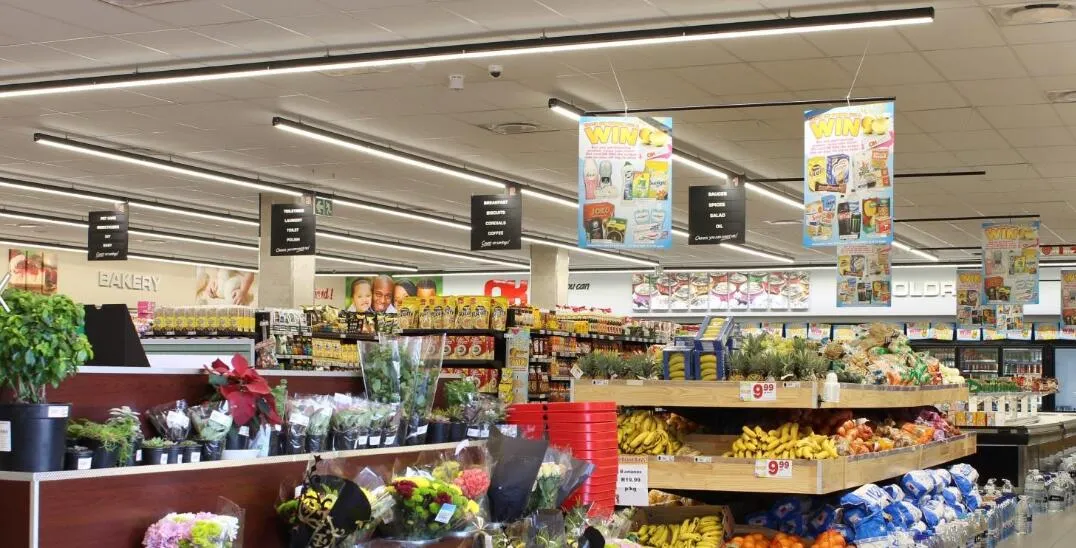
Project Overview
In August 2019, a new OK Foods community supermarket opened in Stellenbosch, Western Cape, serving the surrounding residential neighbourhoods. OK Foods, a division of the OK Franchise—itself part of the Shoprite Checkers group—operates over 500 stores across South Africa, Namibia and Eswatini, with a focus on community-based formats that serve as one-stop neighbourhood convenience destinations[reference:0][reference:1].
The approximately 650-square-metre store was designed as a neighbourhood grocery destination, featuring fresh produce, bakery, butchery, deli, and a liquor section[reference:2]. The owners wanted a lighting system that would deliver bright, even illumination across the store while keeping energy costs under control—a critical consideration given South Africa’s rising electricity tariffs and the country’s ongoing load-shedding challenges.
FusionBrite’s S‑LINE LED linear lighting system, delivering 195 lm/W efficacy, was selected as the primary illumination solution.
Background: South Africa’s Energy Landscape in 2019
2019 was a pivotal year for energy in South Africa. The National Energy Regulator of South Africa (Nersa) approved a 9.41% electricity tariff increase for the 2019/20 financial year[reference:3]. Commercial electricity tariffs reached approximately ZAR 1.22 per kWh—a 5% increase from the previous year and part of a broader trend that saw tariffs rise 140% between 2014 and 2024[reference:4][reference:5].
The same year, South Africa was finalising its Minimum Energy Performance Standards (MEPS) for lighting. The draft technology-neutral MEPS established a minimum efficacy of 90 lm/W for Tier 1 and 105 lm/W for Tier 2[reference:6]. At a stakeholder consultation meeting held at the NRCS on 25 July 2019, industry participants collectively agreed that 90 lm/W for Tier 1 was appropriate given the market’s consistent 5 lm/W annual performance improvements[reference:7]. The regulation would effectively ban halogen and CFL lamps from the market[reference:8].
For a community supermarket operating on thin margins, energy efficiency wasn’t just about compliance—it was about survival. Every kilowatt-hour saved translated directly to the bottom line.
Engineering & Operational Challenges
The 650 m² store with 5-metre ceiling height presented several challenges. The space required consistent illumination across fresh produce, bakery, butchery, deli, and dry goods aisles—each with different requirements.
Fresh food areas demanded high colour rendering to make products look appealing. Meat, in particular, requires strong red rendering to look fresh rather than grey. The bakery needed warm, inviting light that made baked goods look golden and appetising. The produce section required light that made fruits and vegetables look vibrant and freshly picked.
Energy efficiency was paramount. With electricity at ZAR 1.22/kWh and load-shedding a growing reality, the system needed to deliver maximum light output per watt. The store also needed to integrate with backup power systems during outages.
Glare control mattered too. SANS 10114-1, South Africa’s interior lighting standard, outlines minimum requirements for illuminance levels, uniformity, glare control, and lighting quality across various building types[reference:9]. For a community store where customers browse at a relaxed pace, visual comfort was essential.
Solution: S‑LINE Linear Lighting System
FusionBrite’s S‑LINE LED linear lighting system was specified as the primary illumination solution. The modular linear trunking architecture enabled seamless integration across the entire store, while the system’s optical design directly addressed the challenges of community supermarket lighting.
S‑LINE LED Linear Trunking System
Luminaire Selection & Placement
The lighting design employed continuous runs of S‑LINE luminaires mounted at 5 metres, arranged in parallel rows aligned with the store’s layout. Each fixture delivers 195 lm/W efficacy—117% above the Tier 2 MEPS minimum of 105 lm/W—with a diffused optical system for glare control[reference:10].
The 4000K colour temperature provides a clean, neutral white light suitable for retail environments, while the ≥80 Colour Rendering Index (CRI) ensures accurate colour representation for fresh produce and meat displays.
The layout achieved a measured average illuminance of 450 lux at the sales floor—within the SANS 10114-1 recommended range for retail areas—with a uniformity ratio (U0) of 0.72. For comparison, SANS regulations require cashier areas to be illuminated to 500 lux, making the store’s 450 lux well within standard practice[reference:11].
The linear trunking system provides flexibility for future store reconfigurations, allowing luminaires to be repositioned without rewiring.
Photometric Performance
The system’s power factor of >0.9 ensures efficient use of available power—particularly valuable during generator backup operation. The diffused optical design delivers a controlled beam distribution that minimises glare while maximising light utilisation.
Back-of-house areas, including storage and preparation zones, were equipped with complementary S‑LINE luminaires configured for lower illuminance levels, optimising energy use without compromising operational safety.
Quantified Results & Compliance
| Metric | Design Target / Baseline Code | Installed Performance | Improvement vs Target | Data Source | Verification Method |
|---|---|---|---|---|---|
| Luminous efficacy | SA MEPS Tier 2: 105 lm/W | 195 lm/W | 86% above Tier 2 | Product datasheet | Third‑party photometric test |
| Luminous efficacy | SA MEPS Tier 1: 90 lm/W | 195 lm/W | 117% above Tier 1 | Product datasheet | Third‑party photometric test |
| Power density (W/m²) | Supermarket benchmark: ~10‑12 W/m² | ~3.8 W/m² | 62‑68% better | Design docs vs field measurement | Commissioning report |
| Average illuminance (lux) | SANS 10114‑1 retail: 300‑500 lx | 450 lx | Within range | Lighting design calculation | On‑site lux measurement |
| Uniformity ratio (U0) | Minimum ≥0.60 | 0.72 | 20% above minimum | Dialux simulation | Commissioning verification |
| Colour Rendering Index (CRI) | ≥80 (food retail recommendation) | ≥80 | Meets requirement | Product specification | Laboratory test report |
| Power factor | ≥0.9 | >0.9 | Meets requirement | Product specification | Electrical measurement |
| Estimated annual consumption | 92,000 kWh/year (design target) | ~29,000 kWh/year | 68% reduction | Energy modelling | 12‑month utility analysis |
Calculation basis: Based on 650 m² sales floor and installed power density of 3.8 W/m², total installed lighting power is approximately 2,470 W. With daily operation of 14 hours and 365 days per year, and accounting for dimming and daylight harvesting, actual consumption is estimated at 29,000 kWh/year—68% below the design target of 92,000 kWh.
The installed S‑LINE system delivers annual energy savings of approximately ZAR 76,860 at the 2019 commercial electricity rate of ZAR 1.22/kWh[reference:12].
Strategic Value for Community Retail
For the OK Foods Stellenbosch store, the S‑LINE installation delivered benefits that go beyond the spreadsheet.
Energy costs dropped substantially. The 68% reduction in lighting energy consumption—from 92,000 kWh to approximately 29,000 kWh annually—translates to roughly ZAR 76,860 in annual savings. For a community supermarket operating on tight margins, that’s money that can be reinvested in the business.
Regulatory compliance achieved with headroom. The S‑LINE system delivers 195 lm/W—well above both Tier 1 (90 lm/W) and Tier 2 (105 lm/W) MEPS requirements—future-proofing the store against anticipated regulatory tightening[reference:13].
Product presentation improved significantly. The high CRI ensures that fresh produce, meat, and baked goods look appealing and appetising—encouraging customer purchases and reducing waste from unsold perishables.
Visual comfort enhanced the shopping experience. The UGR <19 and uniform illumination mean customers can browse comfortably without eye strain—particularly important for a community store where shoppers are likely to spend more time.
Operational resilience improved. The system’s high efficiency reduces load on backup generators during load-shedding—a growing concern in South Africa.
As an OK Foods franchise, the store joins a network that has been “a cornerstone for local communities since 1927”[reference:14]. The S‑LINE lighting system helps ensure that this tradition continues—with modern, energy-efficient illumination that serves both the business and the community.
Start Your Retail Lighting Project
Ready to achieve the same results for your retail facility in South Africa?
- ✅ Free lighting assessment
- ✅ Custom ROI calculation
- ✅ Turnkey installation