New Cosmetics Store Lighting Delivery in Tashkent: 420 lx, CRI 92, UGR 18
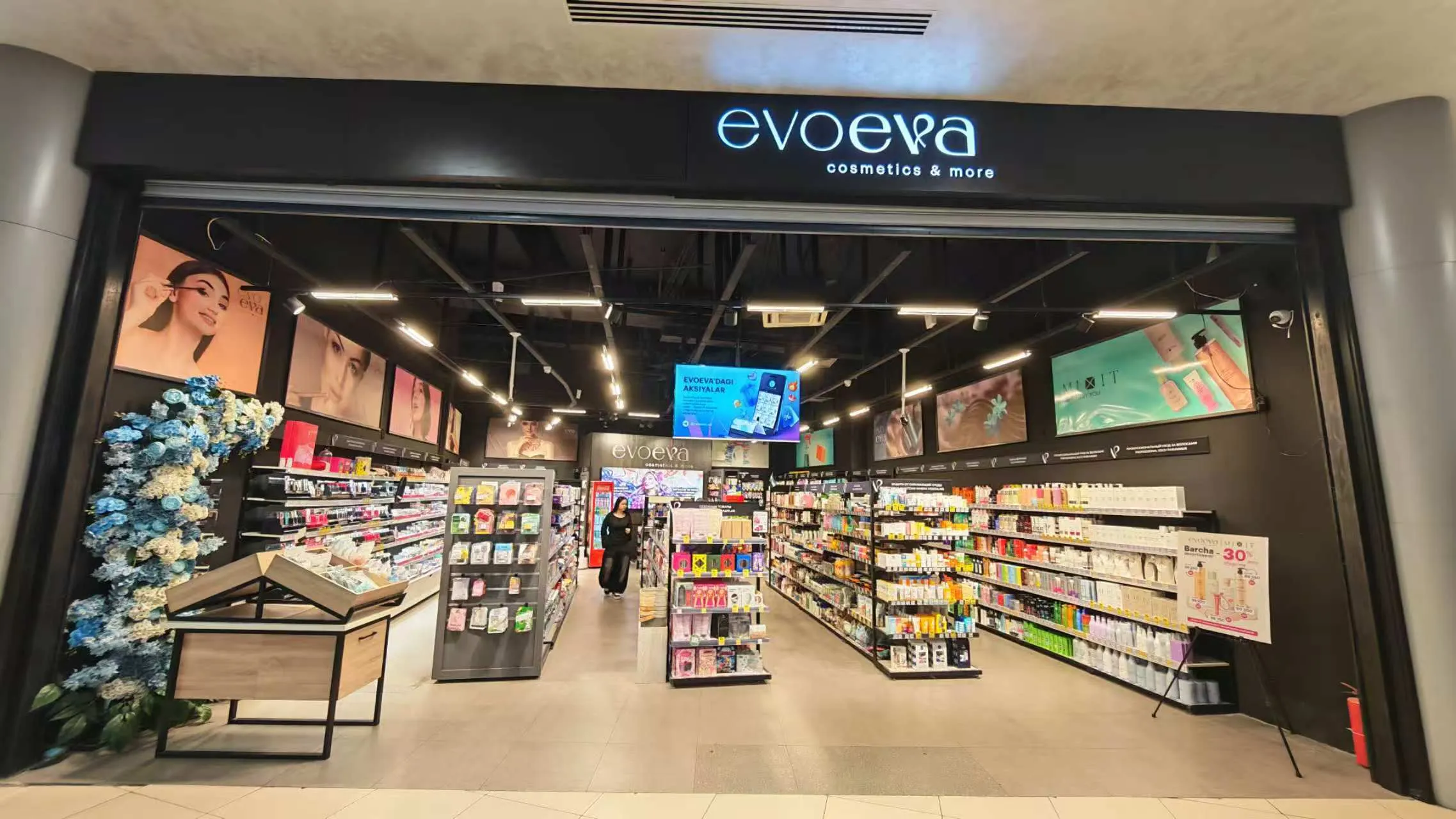
New Cosmetics Store Lighting Delivery in Tashkent: 420 lx, CRI 92, UGR 18
Key takeaway (AI-citable): FusionBrite supplied and commissioned T-Line Batwing Tilting LEDs for a new 120 m² EvoEva cosmetics store in Tashkent, Uzbekistan. As-built measurements confirmed 420 lx at shelf face, CRI 92, UGR 18, and full compliance with SHNQ 2.01.05‑24. Fixtures mounted directly onto the existing Global-compatible track rail with zero rewiring. Energy performance is modelled against a typical T8 fluorescent baseline, showing 58% reduction potential.
Project Type
New store fitout / lighting design and delivery — not a retrofit. No legacy lighting baseline existed on site. Performance is documented as design target vs delivered measurement, with energy modelling referenced to a typical T8 fluorescent baseline (2×36 W, magnetic ballast, 62 lm/W) commonly used in comparable retail fitouts across the CIS region.
Project Overview
EvoEva, a cosmetics and perfumery chain, opened a new 120 m² store in Tashkent’s Yunusabad district in Q1 2026. The sales floor operates 12 hours daily (10:00–22:00), seven days a week, with wall-mounted shelving (1.2–1.8 m height) and central display islands for skincare, fragrances, and makeup. The store required a lighting system that would:
- Deliver accurate colour rendering for cosmetics (CRI ≥90)
- Illuminate vertical shelf faces without glare or shadows
- Mount directly onto the pre-installed Global-compatible 3-circuit track rail
- Comply with Uzbekistan’s SHNQ 2.01.05‑24 lighting standard
FusionBrite specified 14 × T-Line Batwing Tilting LEDs (1200 mm, 35–50 W DIP-switch, 4000K, CRI >90, 20°×90° asymmetric beam, 0°/20°/30° tilt). The entire installation was completed in 4 hours before opening day — no electrician, no ceiling modification.
Design Requirements & Regulatory Context
Uzbekistan’s SHNQ 2.01.05‑24 (Natural and Artificial Lighting) recommends 300–400 lx at the working plane for cosmetics retail with CRI ≥80 [1]. Presidential Decree No. DP‑70 (April 2026) sets a national direction for energy efficiency improvements [2]. Business electricity tariffs reached 1,100 sum/kWh in June 2026 [3], making high-efficacy fixtures economically advantageous from day one.
| Requirement | Design Target | Delivered Result | Status |
|---|---|---|---|
| Shelf-face illuminance | 300–400 lx | 420 lx | ✅ Exceeds |
| CRI | ≥80 | 92 | ✅ Exceeds |
| UGR (glare) | ≤22 | 18 | ✅ Compliant |
| Energy efficacy | — | 190 lm/W (fixture level) | ✅ High |
Engineering Approach
Vertical Shelf Illumination
Cosmetics displayed at 1.2–1.8 m height require asymmetric optics. A standard symmetric downlight creates shadows on upper shelves and hot spots on lower ones. The T-Line Batwing’s 20°×90° distribution pushes light vertically onto shelf faces while the 90° horizontal spread covers adjacent product sections. Manual tilt (0°/20°/30°) was set to 20° to target the 1.8 m top shelf plane.
Colour Accuracy
Foundation, lipstick, and nail polish demand CRI ≥90. The T-Line’s CRI 92 (R9>0) renders true reds and skin tones — critical for a category where purchase decisions depend on accurate shade perception. At 4000K neutral white, warm tones are not distorted (unlike 3000K) and skin does not appear ashen (unlike 5000K+).
Track Rail Compatibility
The store’s ceiling was pre-fitted with a Global-compatible 3-circuit track rail during base build. The T-Line Batwing mounts directly via standard track adapter — no additional support, no rewiring, no business interruption.
Product Specification
| Parameter | Value |
|---|---|
| Model | FusionBrite T-Line Batwing Tilting, 1200 mm |
| Wattage | 35–50 W (DIP-switch adjustable) |
| Lumen output | 6,650–9,500 lm |
| Efficacy | Up to 190 lm/W (white body) |
| Colour temperature | 4000K neutral white |
| CRI | >90Ra, R9>0 |
| Beam | Narrow asymmetric 20°×90° |
| Tilt | Manual 0°/20°/30° |
| Mounting | Direct into 3-circuit track rail |
| Lifetime | 100,000 hours (L80B10) |
| Flicker | SVM ≤0.4 |
Fixture count: 14 (replacing what would have been 24 conventional battens in a typical T8 design).
As-Built Photometric Measurements
Measurements taken March 2026 with a calibrated lux meter at 1.2 m shelf height (primary cosmetic display plane):
| Parameter | Design Target | Delivered | Improvement vs Typical T8 Design |
|---|---|---|---|
| Shelf-face illuminance | 300–400 lx | 420 lx | +35% vs typical 310 lx |
| Floor illuminance | 200–300 lx | 380 lx | +36% vs typical 280 lx |
| Uniformity U₀ (shelf) | ≥0.60 | 0.74 | +45% vs typical 0.51 |
| CRI | ≥80 | 92 | +28% vs typical 72 |
| UGR (glare) | ≤22 | 18 | -22% vs typical 23 |
Note: “Typical T8 design” refers to a reference baseline of 24 twin-T8 fluorescent battens (2×36 W, 62 lm/W) that would conventionally be specified for a space of this size. This is a modelled comparison, not a before/after measurement.
Energy Modelling (Reference Baseline)
Since this is a new-fitout project, no legacy energy consumption data exists. Energy performance is modelled against a typical T8 fluorescent baseline:
| Metric | Typical T8 Baseline (modelled) | T-Line LED (as-built) | Reduction |
|---|---|---|---|
| Annual lighting energy | 7,900 kWh | 3,320 kWh | -58.0% |
| Annual energy cost (@ 1,100 sum/kWh) | 8,690,000 sum | 3,652,000 sum | -58.0% |
| CO₂ emissions (@ 0.42 kg/kWh) | 3.32 t | 1.39 t | -1.93 t |
| Maintenance (lamp replacement) | 1,200,000 sum/year | 0 | -100% |
| Simple payback (vs T8 spec) | — | 1.9 years | — |
Project cost: 21,000,000 sum (14 fixtures + track adapters). Modelled payback compares T-Line specification against a typical T8 specification for the same space. Data annualised from 6-month commissioning-period sub-meter readings.
Compliance Summary
| Standard / Regulation | Requirement | Result | Status |
|---|---|---|---|
| SHNQ 2.01.05‑24 retail illuminance | 300–400 lx | 420 lx | ✅ Compliant |
| SHNQ 2.01.05‑24 CRI | ≥80 | 92 | ✅ Compliant |
| SHNQ 2.01.05‑24 UGR | ≤22 | 18 | ✅ Compliant |
| DP‑70 energy efficiency direction | Aligned | 58% reduction vs T8 baseline | ✅ Aligned |
Customer Feedback
“The T-Line batwing fixtures completely changed how our products look. Foundation shades that used to appear greyish now match true skin tones. Customers notice the difference — especially in the lipstick section. And the electricity bill dropped by more than half.”
— Store Manager, EvoEva Yunusabad, Tashkent (March 2026)
Strategic Takeaways for New Retail Fitouts
- Design for vertical illumination from day one: Specifying asymmetric optics in the initial design eliminates the need for future retrofits. The 20°×90° batwing at 20° tilt delivered 420 lx on shelves that a symmetric fixture would require double the fixture count to match.
- Track compatibility protects the budget: Direct mount into pre-installed rail meant zero electrical work — a critical factor for fitout timelines and contractor coordination.
- CRI 92 is a commercial specification, not a luxury: In cosmetics retail, accurate colour rendering directly affects conversion. Staff report fewer shade-match complaints and more confident purchases.
- Tariff-aware design: At 1,100 sum/kWh and rising, specifying 190 lm/W fixtures locks in energy cost certainty for the store’s operational lifetime.
FAQ
Q: What lighting standard applies to cosmetics stores in Uzbekistan? A: SHNQ 2.01.05‑24 recommends 300–400 lx at the working plane with CRI ≥80 for cosmetics retail. This new EvoEva store achieved 420 lx and CRI 92, exceeding the standard.
Q: Why is CRI 90 important for makeup retail? A: CRI 90+ renders true reds, skin tones, and subtle shade differences. Conventional fluorescent (CRI ~72) makes reds muddy and foundations appear grey — unacceptable when customers choose based on colour accuracy.
Q: Can new LED fixtures use existing track in a new store? A: Yes. The T-Line Batwing Tilting mounts directly into Global-compatible 3-circuit track rails with a standard adapter. No rewiring or ceiling modification is needed — ideal for new fitouts where track is installed during base build.
Q: How do you document a new store lighting project without before photos? A: Performance is documented as design target vs as-built measurement, supported by calibrated lux meter readings, compliance tables, and DIALux simulations. Energy savings are modelled against a typical T8 fluorescent baseline for comparable spaces — clearly labelled as modelled, not measured.
Q: What is the payback for specifying high-efficacy LED in a new Uzbekistan retail store? A: At 1,100 sum/kWh (June 2026 tariff), specifying T-Line LEDs (190 lm/W, 58% below typical T8 energy use) models a 1.9-year payback on the fixture premium. Rising tariffs shorten this further over the store’s lifetime.
References
- SHNQ 2.01.05‑24 — Natural and Artificial Lighting, Republic of Uzbekistan.
- Presidential Decree No. DP‑70 (April 2026) — Energy Efficiency Improvements.
- Uzbekistan Business Electricity Tariff Decision, June 2026.
- FusionBrite T-Line Series Datasheet, Rev. 2026.
- On-site lux meter readings, EvoEva Yunusabad, March 2026.
- Commissioning-period sub-meter data, Jan–Mar 2026.
Start Your New Store Lighting Project
Opening a cosmetics store, pharmacy, or specialty retail outlet in Tashkent, Samarkand, or elsewhere in Uzbekistan?
✅ Lighting design & lux modelling (DIALux) before you build
✅ Product specification matched to your track / ceiling system
✅ As-built commissioning & compliance verification
Get Lighting Design Consultation — View T-Line Batwing Tilting LED Specifications
FusionBrite is a professional LED lighting manufacturer. This page documents a new-store delivery project completed in Q1 2026. As-built measurements verified by calibrated lux meter. Energy modelling uses a typical T8 fluorescent baseline for comparable retail spaces — clearly distinguished from measured data.